


Belgium’s Port of Antwerp Pilots First CO₂-Neutral Barge Corridor in Europe
By Maria Kalamatas | August 1, 2025
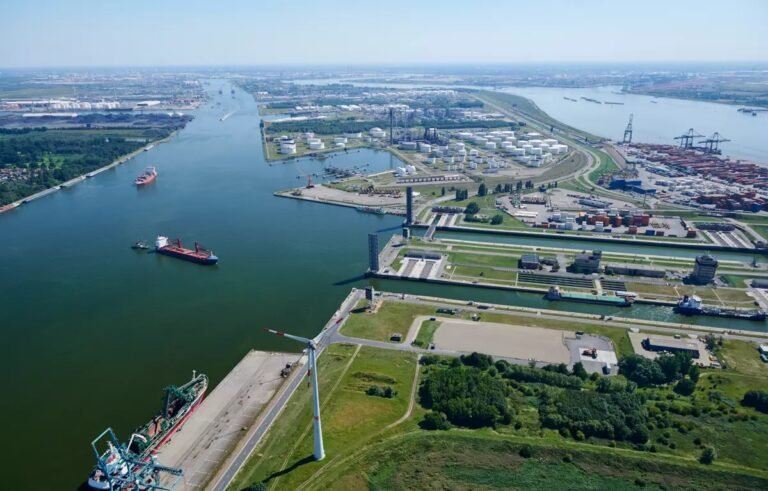
Antwerp — On the grey, quiet waters of the Scheldt, a quiet revolution is underway. This morning, the Port of Antwerp-Bruges officially launched Europe’s first fully CO₂-neutral inland barge corridor, connecting the port to Genk and Liège using hydrogen-powered and electric barges supported by onshore renewable infrastructure.
“This is no longer a test,” said Koen Bollen, sustainability director for the port. “We’re operational. Fully neutral. And scalable.”
Zero-emission logistics enters the bloodstream
The route, stretching nearly 160 kilometers inland, is serviced by two electric push barges and one green hydrogen unit, built in partnership with Dutch shipbuilder Concordia Damen. Charging infrastructure along the Albert Canal is powered by solar and wind farms operated by local cooperatives.
“This is the first corridor where the entire value chain — propulsion, energy source, and terminal — operates without emitting a single gram of CO₂,” Bollen emphasized.
Retail giants on board
Retailers including Colruyt, Lidl, and Decathlon are among the first users. They’re using the route to transport non-perishable goods, textiles, and equipment into distribution hubs in Flanders and Wallonia.
“By 2027, 25% of our Belgian inbound freight will move on zero-emission corridors,” confirmed Julie Martens, logistics lead at Colruyt. “It’s no longer about image — it’s about resilience and cost control.”
Policy aligned with action
The project is co-financed by the EU Green Logistics Accelerator Fund and backed by Belgium’s National Climate Adaptation Strategy 2030. The port authority expects to reduce up to 12,000 tonnes of CO₂ annually, with expansion into northern France under review for Q4 2025.
Environmental NGOs like Transport & Environment have praised the project as a “working model” that combines industrial efficiency and ecological alignment.
“This is what the Green Deal looks like in motion,” said Elise Delcourt, senior analyst at T&E. “It’s not theory — it’s tonnage moved without burning fuel.”
Scaling the model
Antwerp’s corridor will be closely watched by ports in Rotterdam, Hamburg, and Marseille, all exploring similar shifts. A Brussels think tank recently suggested such corridors could handle 30–40% of European short-haul freight traffic by 2030, if replicated widely.
For now, the low hum of battery-powered propulsion replaces diesel engines on Belgium’s inland waterways — and the future of sustainable freight just got a little quieter.
The post Belgium’s Port of Antwerp Pilots First CO₂-Neutral Barge Corridor in Europe appeared first on The Logistic News.
Share this post

Related
Posts
The United States seizes a 7th tanker: pressure mounts on sanctioned ships
New episode in the maritime tug-of-war over sanctions: the United States has seized a seventh tanker suspected of operating in...
China replaces US barrels with Canada: new impact on tanker routes
The geography of oil is shifting, and shipping feels it immediately. According to analyzes reported by BIMCO, Chinese crude oil...
The Port of Klaipėda Signs a Record Year Driven by Containers, LNG, and Ro-Ro
The Lithuanian port of Klaipėda announces a historic performance in 2025: 39 million tons handled, despite a tense geopolitical context...
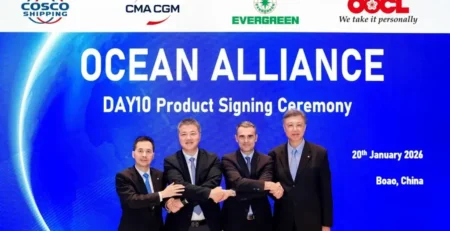
Ocean Alliance maintains the detour via the Cape, while preparing a “Suez plan”
The Ocean Alliance (CMA CGM, COSCO Shipping, Evergreen, and OOCL) has just unveiled its “Day 10” East-West network, which will...