


Automotive shipments drive Lufthansa Cargo business
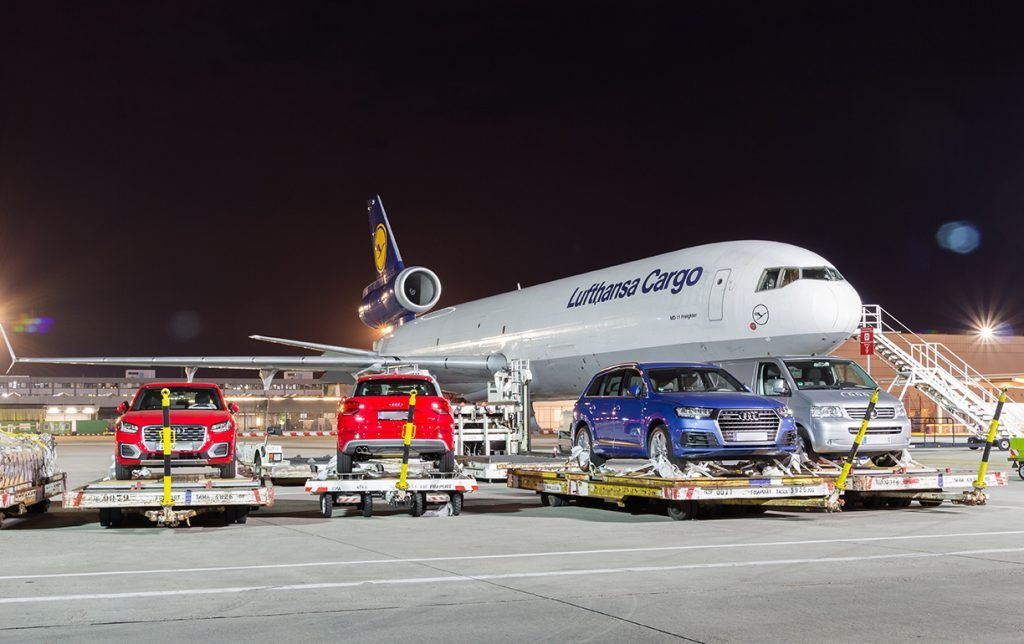
Lufthansa Cargo is continuing to deepen its presence in the automotive sector, a market it identified in 2024 as one of its strategic focus industries.
The German carrier’s cargo division has been building tailored airfreight solutions for vehicle manufacturers, suppliers and logistics partners, covering everything from urgent production shipments to complete vehicles and highly valuable automotive assets. At the same time, it is adapting its services to meet the growing complexity of the automotive supply chain.
According to Lufthansa Cargo, modern vehicle manufacturing now depends on globally interconnected production networks, modular platform structures and increasingly compressed development cycles. In that environment, speed, flexibility and resilience have become critical, and airfreight plays an essential role in keeping production lines running, accelerating launches and transporting sensitive or high-value components reliably.
Frank Bauer, chief operations officer at Lufthansa Cargo, said automotive customers expect the highest levels of speed and reliability, and added that the airline’s global network and specialist teams help ensure supply chains remain stable even under intense time pressure.
A recent charter operation highlighted that capability. At the end of January, when a shortage of parts threatened production in Belgrade, Serbia, Lufthansa Cargo deployed an Airbus A321 freighter less than 24 hours after receiving the urgent request. The aircraft was loaded in Vienna, using 13 maindeck positions and 10 lower deck positions, and two additional charter flights followed in the days after to meet the urgent demand.
The carrier has also shown that it can scale up operations for larger industrial programmes. In February, Lufthansa Cargo operated 11 A321 freighter charter flights from Casablanca, Morocco, for Mercedes-Benz within just 11 days. The company said the flights were made possible through rapid operational adjustments and close coordination across multiple teams, demonstrating its ability to respond quickly in time-critical production environments.
Lufthansa Cargo is also handling the transport of unique, high-value automotive assets. In early February, for example, it moved an exclusive custom-built vehicle based on a Lamborghini Aventador from Cairo to Europe. Despite short-notice changes involving customs and documentation, the airline said it was able to complete the delivery safely and on schedule.
The automotive vertical is overseen by Rachid Massaoudi, senior manager industry development – automotive at Lufthansa Cargo. He said the company works closely with operational teams to turn individual customer requirements into practical, tailor-made transport solutions.
The growth in automotive logistics forms part of a wider positive trend for Lufthansa Cargo. Earlier in March, the carrier reported strong results for 2025, supported by stable demand, particularly from Europe and Asia.
Full-year revenue rose 4% to €3.4bn, compared with €3.3bn in 2024. Adjusted EBIT increased 29% to €324m, while the adjusted EBIT margin improved by 1.8 percentage points to 9.5%.
Demand, measured in revenue cargo tonne kilometres, climbed 7% year on year to 9.1bn RCTK. Capacity increased 5.4% to 14.5bn available CTKs, and the average load factor improved by 1.1 percentage points to 63%.
Gregor Schleussner, chief financial officer and chief human resources officer at Lufthansa Cargo, said the company had grown by 7.3% last year, more than twice the 3.4% growth rate recorded across the overall market.
Lufthansa Cargo currently operates five cargo hubs in Frankfurt, Munich, Brussels, Vienna and Rome, and serves around 350 destinations in more than 100 countries. On average, it transports 2,500 tonnes of freight per day.
The division markets the belly cargo capacity of Lufthansa Airlines, Austrian Airlines, Brussels Airlines, Discover Airlines, ITA Airways and SunExpress, in addition to its own fleet of 18 Boeing 777 freighters and four Airbus A321 freighters. A further 300 trucks also operate daily under a Lufthansa Cargo flight number.
The post Automotive shipments drive Lufthansa Cargo business appeared first on The Logistic News.
Share this post

Related
Posts
Wamos Air renews long-term ULD partnership with Jettainer
Wamos Air has renewed its long-term partnership with ULD management specialist Jettainer, extending a relationship that began in 2018. The Madrid-based...
Kenya Airways transports first rally cars for 2026 Safari Rally
Kenya Airways has safely flown the first consignment of two high-performance rally cars into Jomo Kenyatta International Airport as preparations...

States sue Trump over 10% global tariff
A coalition of more than 20 U.S. states has filed suit to block the new 10% global tariff imposed by...

CBP says tariff refund process is not ready yet
U.S. Customs and Border Protection has told a federal court that it is not yet able to begin processing refunds...