


‘It’s not just all the big companies’: Warehouse robotics use expands
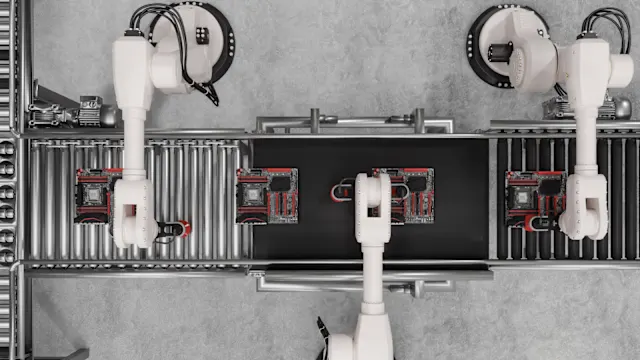
Robotics and artificial intelligence—once largely limited to billion-dollar enterprises with massive supply chains—are becoming increasingly accessible to a much broader range of companies, including mid-sized operators and SMEs.
The shift was on full display at last year’s ProMat event hosted by MHI, where record-breaking attendance and a flood of robotics solutions across the show floor highlighted growing demand, according to Sonya Snellenberger, VP of partnerships at Conexus Indiana, an economic development nonprofit focused on advancing the state’s manufacturing and logistics sectors.
“That’s a huge indicator that there’s an appetite for this,” Snellenberger said, stressing that the momentum extends well beyond the largest players. “It’s not just all the big companies.”
As-a-service drives adoption
A major reason warehouse robotics has become more attainable is the rise of as-a-service platforms, including robotics-as-a-service (RaaS) and software-as-a-service (SaaS), according to Jayesh Mehta, managing executive of industry groups at MHI. These subscription-based models can make automation financially feasible for midmarket businesses by reducing upfront capital requirements.
A 2025 study by MHI, Peerless Research Group and The Robotics Group found that 48% of participating organizations were using robots in their plants and/or warehouses in 2025, up from 23% three years earlier. The survey included 216 respondents (January–February 2025), with more than half representing companies generating less than $50 million in annual revenue.
Running alongside the expansion of robotics use, the 2024 version of the survey found that 64% of responding companies said they were using a RaaS or SaaS system, up from 46% two years earlier.
Examples are multiplying. Mobile accessories distributor Superior Communications is working with Brightpick to integrate 37 multi-purpose autopicker robots into its Tennessee distribution center. Superior CEO Solomon Chen cited the ability to acquire equipment through a RaaS scheme as a key decision factor, noting that the robots are expected to optimize throughput and reduce fulfillment costs.
Parcel carrier UniUni, which operates more than 100 warehouses in North America, began its robotics journey in 2023 through a partnership with Global Robotics Services. The UK-based technology firm promotes a RaaS model that requires lower upfront investment, reduces fixed costs and offers flexible lease terms.
The post ‘It’s not just all the big companies’: Warehouse robotics use expands appeared first on The Logistic News.
Share this post

Related
Posts

CMA CGM suspends Middle East bookings as Iran attacks tankers and refineries
CMA CGM has become the latest global container line to suspend all cargo bookings to the Middle East after Iranian...
TPM26: Middle East conflict to ripple across global trade lanes
At the TPM26 conference in Long Beach, container shipping executives warned that the operational ripple effects of the Middle East...

Carriers pause India–Middle East cargo bookings amid Persian Gulf port chaos
Supply chains between India and the Middle East have ground to a near standstill after multiple ocean carriers suspended services...
Whirlpool to lay off over 300 at Iowa plant as Machinists try to save jobs
Whirlpool plans to lay off 341 employees at its manufacturing facility in Amana, Iowa, beginning March 9, according to a...