


Germany Lays Foundations for a New Era in European Land Transport
Berlin, Germany
By Maria Kalamatas | The Logistic News
May 26, 2025 – Section: Land
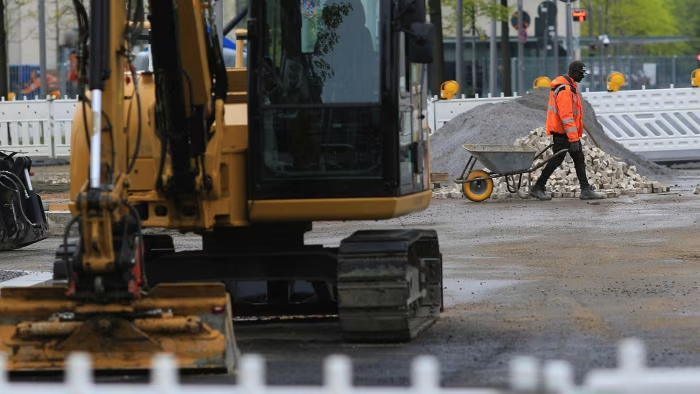
This week, Germany reached a turning point in its infrastructure ambitions. On the Baltic coast, construction teams began placing the first concrete segments of the Fehmarnbelt Tunnel — a vast underwater corridor that will eventually connect northern Germany to Denmark by both road and rail.
When finished, the tunnel will stretch nearly 18 kilometers beneath the sea, linking the island of Fehmarn with the Danish region of Lolland. More than just a feat of engineering, it’s a strategic move to bring Europe’s logistics network closer together.
“We’re closing a historic gap,” said Dr. Klaus Müller, senior advisor at the Federal Transport Ministry. “This tunnel isn’t just about Germany and Denmark — it’s about connecting Europe more intelligently.”
Travel time between Hamburg and Copenhagen will drop from nearly five hours to under three by train. Freight trucks will avoid delays at ferry crossings. Rail operators will run uninterrupted cargo services between Scandinavia and Central Europe. For a continent increasingly focused on green and efficient supply chains, this link couldn’t come at a better time.
The tunnel, under construction since 2021, will carry a dual-track rail line and a four-lane highway. It’s part of the broader Trans-European Transport Network — a program designed to create seamless corridors for goods and passengers across the continent.
“If you want to move cleaner and faster, you have to build smarter,” added Müller. “This tunnel is part of that equation.”
Beyond logistics, the environmental payoff is substantial. The shift from ferries and road traffic to rail is projected to slash emissions in the region over the coming decades. Engineers have also implemented special construction safeguards to protect the Baltic ecosystem, with continuous oversight from both German and Danish environmental agencies.
Germany expects the tunnel to open before the end of the decade. But its impact will last far longer — not just in transit times, but in the way countries think about infrastructure: as a driver of connection, sustainability, and continental unity.
✎ Maria Kalamatas
Senior Correspondent – Land Transport & Sustainability
The Logistic News
The post Germany Lays Foundations for a New Era in European Land Transport appeared first on The Logistic News.
Share this post

Related
Posts
Iran conflict drives volatility in air cargo rates
The escalation of the Iran conflict is already having a visible impact on global air cargo markets, according to newly...
Quito unveils airport expansion plans and new route ambitions
International aviation experts gathered in Quito this week to discuss the future of airport-led development as the operator of the...

Saudia Cargo, Mawani and ZATCA launch sea-air logistics corridor
Saudia Cargo has announced an expanded strategic collaboration with the Saudi Ports Authority, Mawani, and the Zakat, Tax and Customs...

Deutsche Aircraft appoints Nils Heuer as director of global sales
Deutsche Aircraft has appointed Nils Heuer as director of global sales, reinforcing its commercial team at a pivotal stage in...